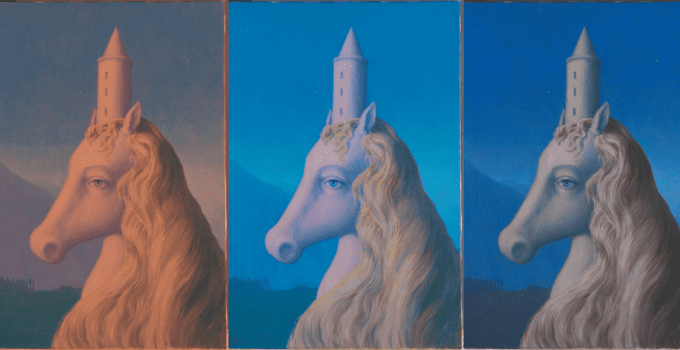
One of the most captivating pieces on display in the Scaife Galleries at the Carnegie Museum of Art in Pittsburgh is a mesmerizing 1956 painting by René Magritte called « The Heart of the World. » This painting, completed after Magritte had already established himself as one of the most influential Surrealists, features a feminine unicorn with flowing blonde hair set against a fantastical mountainous landscape. The unicorn’s horn is depicted as a fairy-tale tower, and a single blue eye can be seen beneath it, with stars twinkling in the sky above.
While « The Heart of the World » may not have the same level of recognition as other famous works in the museum’s collection, such as Monet’s « Water Lilies » or Van Gogh’s « Wheat Fields After the Rain, » it more than makes up for it in its evocative nature and the sense of mystery it evokes. The painting raises questions about its symbolism and what the unicorn and castle might represent.
Magritte, known for his use of personal symbols like apples, bowler hats, and mirrors, creates a dreamlike world in his art that can be interpreted in various ways. While some may see phallic symbols or references to chastity in « The Heart of the World, » the painting remains open to interpretation. The unicorn in the painting, as noted by Juan Eduardo Cirlot, has « ambivalent implications » that add to its enigmatic allure.
Symbolic interpretation, often dismissed as outdated or simplistic, offers a way to uncover deeper meanings in art and literature. While some may view it as a relic of a bygone era of literary study, the symbolic tradition dates back to ancient times and continues to be a powerful tool for exploring the complexities of human communication. By delving into the world of symbols, we can unlock layers of meaning that go beyond surface-level interpretations and connect us to a shared human experience that transcends time and culture. A unicorn is always more than just a unicorn, and it goes beyond notions of chastity, purity, and virginity as well. In his work « A Dictionary of Symbols, » Spanish author Cirlot presents symbols as dynamic realities imbued with emotional and conceptual significance, representing true life. Symbolic reading is not about decoding literature like a puzzle, but rather about exploring a cultural wonder cabinet where allusions and connotations touch the eternal, creating a dialogue with a multitude of meanings that precede the work itself.
Cirlot’s dictionary delves into both conventional symbols like wheels, crosses, and serpents, as well as more unconventional ones such as the septenary, cromlech, and Omphalos. The work incorporates elements of Astrology, Gnosticism, Alchemy, and Kabbalah, highlighting the spiritual dimensions that play a significant role in symbolism. While some may view symbols as outdated remnants of archaic storytelling, Cirlot emphasizes their ever-shifting, ambiguous, and dream-like nature, challenging readers to interpret them beyond simple allegories.
Living symbolically, as advocated by philosophers like Gaston Bachelard, means existing in a network that transcends time and connects to countless works yet to be created. Symbols hint at the possibility of profound meaning without offering definitive answers, maintaining a belief in significance. The unicorn, a symbol of purity and innocence in Medieval art, embodies various meanings across different cultures and time periods, reflecting themes of tradition, subversion, and freedom.
Symbols like Williams’s red wheelbarrow, Fitzgerald’s green light, Melville’s white whale, and Kafka’s vermin exist in the realm between the abstract and concrete, teasing meaning that remains elusive yet compelling. These symbols invite interpretation while retaining an element of mystery, prompting us to continually seek deeper understanding. In the end, symbols are shadows that provoke questions about what lies beyond, inviting us to explore the infinite layers of meaning they contain. À la recherche d’un sens profond, il est facile de l’effrayer, tel un impur s’approchant d’une licorne, de la même manière que répéter un mot encore et encore le vide de sa cohérence. Ce qui importe n’est pas tant la signification de ces images (du moins pas entièrement), mais le fait que leur existence maintient une croyance en la signification. Les symboles peuvent être silencieux, mais ils ne sont pas agnostiques.
Mircea Eliade affirme dans Images et Symboles: Études de Symbolisme Religieux que l’importance de son sujet est que « la pensée symbolique ouvre la porte sur une réalité immédiate pour nous… vu sous cet angle, l’univers n’est plus scellé, rien n’est isolé dans son propre existence: tout est relié par un système de correspondances et d’assimilations. » Dans le crépuscule algorithmique du sens, lorsque l’intelligence artificielle insère robotiquement des images dans l’écriture par modèle et que l’intentionnalité est absente, le symbolique est un moyen de nous rappeler que tous nos mots ont d’abord été prononcés par d’autres êtres humains pensants, croyants et respectueux, remontant jusqu’à cet Australopithèque et sa pierre, que nous puissions les comprendre ou non.
Lorsque Dante a imaginé son approche de Dieu à la conclusion de La Divine Comédie, le Seigneur est apparu comme ce symbole parfait du cercle, où nous sommes tous des pages « liées par l’amour en un seul volume, » tout dans l’existence n’étant rien de moins et rien de plus qu’un symbole transcendant pour lui-même, les enchantements mêmes de la réalité. Compris de cette manière, le symbolique n’est rien de moins que l’interaction de significations variables, des négociations qui se produisent entre les lecteurs et ce qu’ils lisent afin de saisir l’ineffable, même si cette roue tourne toujours, obscurcissant une partie du tout aussi clairement qu’elle en révèle une autre.